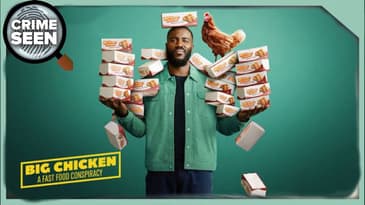
Crime Seen is the true crime review podcast that gets to the heart of how true crime stories are told. Join Mari Forth @maritalks2much.bsky.social and Sarah Carradine @sarahcarradine.bsky.social as they put true crime properties under the magnifying glass. In this episode they examine Big Chicken: A Fast Food Conspiracy on Netflix. Joining them is Aysha Welch @ayshalikeasia.bsky.social
How many magnifying glasses out of 5 will they rate the documentary? Listen to find out. Or jump to the ratings at about 41.12
Crime Seen live show Thursday August 27 at 1pm at RHAPCon. Live panel discussion Thursday August 27 3pm, hosted by Matt Scott & Mari Forth
Link to Aysha's previous episode: Devoured episode 3 "We All Scream" on the Bluebell Ice-cream listeria outbreak scandal
https://crimeseenpod.com/episode/crime-seen-episode-12-devoured-27fq
Recommendations:
docu-series: Should I Marry A Murderer? (Josh Allot, 2026)
documentary: A Child Of My Own (Maite Alberdi, 2026)
reality: Locked Ups (Netflix)
documentary: Food Inc (Robert Kenner, 2008)
documentary: Hot Coffee (Susan Saladoff, 2011)
You can jump to the recommendations at about 48.40
Next time on Crime Seen: Tony Cox youtube.com/@GentsMakingSense joins the pod to discuss Freefall: A Reckoning For Boeing. Watch it on Netflix and send in your comments and questions.
Find Crime Seen merch at maricrafts2much.bigcartel.com/product/crime-seen-podcast-cup
Support the creators at buymeacoffee.com/crimeseenpod
Find Aysha at:
Life Bi Us: https://www.youtube.com/@LifeBiUs
Married At First Sight recaps: https://robhasawebsite.com/shows/reality-tv-rhapups/married-at-first-sight/
Find Mari at:
Recap Kickback: https://recapkickback.com/ & youtube.com/@recapkickback
Big Brother recaps: https://robhasawebsite.com/shows/big-brother-podcast-rhap/
Find Sarah at:
Something's Off podcast: https://www.youtube.com/@SomethingsOffPod
These Are Their Stories…: https://www.lawandorderpodcast.com/
Babes In The Conclave - The Traitors Hungary season 3: https://www.youtube.com/@BabesintheConclave
Theme music by Will From America @willfromamerica.bsky.social
Logo by Tricky Rice @trickyrice.bsky.social
Subscribe to the feed at crimeseenpod.com to get your true crime on Tuesdays
You can follow the show @CrimeSeenPod on Bluesky, Instagram, Threads & Facebook, and @crime.seen on TikTok
Send us your feedback and recommendations for future episodes by email to CrimeSeenPod@gmail.com or by voice memo at speakpipe.com/CrimeSeenPod
Learn more about your ad choices. Visit megaphone.fm/adchoices
[00:00:25] I'm Mari Forth I'm Sarah Carradine, podcasting from unceded Gadigal land. And this is Crime Seen, the true crime review podcast where we get to the heart of how true crime stories are told. As most listeners know by now, we're going to be in Milwaukee in, I think that's in Wisconsin. Should we buy some cheese? I think so. We're going to be at RHAP Con August 26th, 27th and 28th.
[00:00:49] We're going to be there the whole three days, but we'll be recording an episode live on Thursday the 27th at 1pm. We'll also be doing a live panel on podcasting hosted by Matt Scott and Mari. And also Mari and I will be playing the newlywed game apparently, I just found out. So it's going to be pretty packed. Mildred messaged us to say, I live in Milwaukee. Oh, sorry about the cheese comment, Mildred.
[00:01:17] So excited you are coming here. Can't wait to actually see you. Thanks, Mildred. Who else is coming? Hmm. We'd love to see you there. Yes. Yeah. Shout out to Mildred. See you in Wisconsin. Last week we watched the Idaho murders, College Nightmare with Mel Barrett. Mari, what did we watch this week? This week we watched Big Chicken, a fast food conspiracy on Netflix.
[00:01:43] It was directed by Liana Stewart, produced by Louis Theroux and written by Mo Gilligan. And here's someone else you can see in Milwaukee. Joining us is our favorite Texan, Asia Welch. Asia, how are you? I'm doing well. So excited to be here. This is my third time here, I think, right? Is it three? Yes. Yeah. You know, Jason's blowing me out of the water. Yeah.
[00:02:12] What was the second time? First was Blue Bell. Second was the Top Model documentary. Yes. And now we're back to food. We're back here to food. Our food correspondent. You don't like the murders. You don't like murdering chickens, but apparently. Oh, I was watching this and then I was like, ah, now I can see why I was invited. I was so excited to see the locations he went to, but. And he went to so many. So I'm so glad we have you here.
[00:02:42] Our resident traveler, one of our TikTok correspondents, our Houston know-it-all. So, uh, so glad to have you here. Um, you know, whenever we can find these weird ones, we'll definitely, we'll definitely send it your way because Jason is blowing you out of the water, but that's because he is our reliable hand. We tell him that every time. Yeah. He's like, they always tap me for the worst things, but. Yep. The dredge of society. We ask him to do it.
[00:03:11] And he said yes every time to us, his fault. So he can't even blame us. Hey, he's a yes man. He's never said no. So that's his fault. Right. So let's get to this documentary, shall we? Mo Gilligan is an award-winning British standup comedian, host and writer. In this documentary, he eats fried chicken three meals a day for a month while investigating all sides of the chicken industry in Britain and the US. That's it.
[00:03:38] I mean, that is literally it. Oh, like we said, crime? Question mark on this one. Question mark? Definitely crime. Definitely crime. I was thinking that too. So I watched this with my girlfriend and her dad. He happened to be passing through, like he was traveling from like another state going back home. And so he stopped here for a night.
[00:04:05] And we were like, do we have a show we want to watch? Watch it with us. And then I was then Sarah, my girlfriend, we were all we were talking like, why? I wonder why this is on crime scene. Like, but we're going to watch it. And then it was like, oh, okay. Yeah. Because their crime is a foot. Right. Right. Crime is a foot. It's not a simple, because I when I saw the description, and I started I was thinking
[00:04:34] like supersize me. Yes, very much. Yeah. Yeah, it's institutionalized crime, right? It's how the institution of big chicken can get away with a lot of crimes umbrella. Asia, tell us about your overall thought. Thought. So it's I liked that it answered questions as I had them. So it's like starting he does his day one his day two. I'm like, I really hope he saw a doctor before this.
[00:05:04] And then boom, previously, two days ago, saw a doctor. And so I was like, okay, this is not going to be good. Because starting out just even one meal with the fried chicken was like, wait a second, he's doing breakfast, lunch and dinner, which, like thinking about it, just in normal life, I think the only the only fast food restaurant that has fried chicken that I would eat breakfast that is Chick-fil-A.
[00:05:34] Chick-fil-A. Forbidden chicken. I know. Jesus. Oh, when their logo popped up, I said no. And then I was also afraid because I'm the type of person that like if I watch something that I can lose my appetite. And so I was eating dinner, but thankfully, it was like spaghetti with ground beef, not chicken. So that made it feel a little bit better. And I did not lose my appetite.
[00:06:02] But boy, did he go on a journey. And I actually thought there would be a point where he wouldn't finish the 28 days for health reasons. I thought like, look, you are fluctuating moods. Like he started to look unhealthy. Like you could see his like his eyes were a little bit more like, yeah, like I was like, oh, no, this is not this is not good.
[00:06:29] Like, and so I really thought that he might tap out, but he did commit. And I was I was glad to see that he stuck it out and that he was able to recover the other side of it. But boy, is that that's dangerous. Yeah, truly. So what about you overall thoughts about this informative documentary? I don't know about you, too, but I know of Mo Gilligan's work.
[00:06:57] I think he's really super interesting, very funny, very forceful, very sort of joyful, even when he's dropping the hammer on things. And I thought we we thought honestly, Asia, we thought we're sick of murder. We're sick of cults. We're sick of all this terrible stuff going on. And let's watch Mo Gilligan eat fried chicken for 28 days and just sort of see again. I was thinking supersize me. Of course, there's a whole lot of controversy about that, which we won't go into now.
[00:07:27] So here we have a fit man in his 30s voluntarily doing this. And I tell you around day 22, when he was crying. Yes, I was saying, just please just stop. Like you're still doing the documentary because as it unfolds, it's about so much more. And I can't tell you how passionately I liked this documentary for how at each step it unfolded more and more and more.
[00:07:55] Instantly, I was I was I sat up straight when he said watching a black man eating fried chicken on on camera gives me pause. And I was like, I mean, tell me about it. So he does the cultural side. He does the historical side. He does the psychological side. He does the activist side. He does the pollution, like all this stuff and slowly unfolding, though, he does. He doesn't hit you in the face with it.
[00:08:23] And I love him starting in Britain with his lunch mates as they all eat fried chicken. And he's one of his friends is particularly worried about him and said, be careful over there. And I thought, oh, yeah, he's talking about don't eat too much chicken. And I thought, oh, no, he's saying be careful as a black man going to to the US. So it was not just covertly about race. It was also overtly about race. And I really appreciated that. I thought it was super good. What about you, Mari?
[00:08:52] What were your overall thoughts? I agree with a lot of the things you said. I think I liked it up until a point. I think a lot of the stuff that I liked about it was stuff that hadn't been addressed in one of these types of documentaries. I've actually watched a lot of these food processing documentaries because nothing, honestly, nothing really moves me when it comes to our food intake and stuff like that. I don't watch it and be like, oh, my God, I'm going to be sick now. I can't eat this and this.
[00:09:22] I process the information and do with it as I will. So I've actually watched a lot of food documentaries, especially like with food processing, government oversight and food stuff. And I'll have a lot of recommendations for that when we get to that part. But like, so the stuff that I had known from those other documentaries, which luckily for this documentary was, I think, contained more near the end.
[00:09:50] That's when it lost me because it was stuff I already knew. But I thought that the stuff in the beginning, I think I found that the beginning and the middle were way more compelling for me than the end of the documentary. Same. I agree. Yeah. Even with that said, I still think it was a really well done documentary. Also, the reheating of the super sized misnachos was kind of like, okay.
[00:10:18] I was like, I wonder if we could have taken a different approach there, but then we wouldn't have had seen the actual effect of it on him. So it was, that was very interesting. I was, I was talking to my husband as I was watching. I was like, he really like put himself into like a hole when he said he has to eat fried chicken specifically every day. Yes. Cause at first I thought he just, it was just chicken, but he's like, no, specifically fried chicken. I was like, why?
[00:10:47] His poor kidneys. His poor kidneys. His poor kidneys fried food. No. I think, I think he, he said something about like a Indian place or something. And I was like, he can't even get chicken tikka masala. Like I don't understand. Like why couldn't he be done a little bit variety, but I guess, you know, it's to really punch home the, the friedness of it, not being good for you.
[00:11:10] So yeah, I mean, overall, like I said, I have a very, a very good, well, well planned out documentary, very entertaining. I just, just some stuff in it. I was like, yeah, you know, getting ready for this mode. So one of the first things that Mo brings up that I thought was kind of funny that I didn't even like really think about until he said it. And then I was like, I guess, but they talk about chicken on social media. Right.
[00:11:39] So Asia's our, our TikTok corresponding here. They were saying chicken is cool and edgy. And they, they pulled up TikToks. I was like, is it? And like, you know, I think it's because, and they were all, they, I think they coupled that with showing like Meg the stallion having her partnership with like Popeye's and like, you get the hottie sauce. And like, uh, people. The hottie sauce is great. I've never tried it. It was delicious.
[00:12:09] I had some stores. You take me there when we were in Milwaukee. I mean, I'll take you there if they have it, but they don't have the hottie sauce. I was like storing the hottie sauce for a minute afterwards too. And that was, that was the time where I was like, oh, okay. Because when they first started, I was like, what do you mean? And then when Meg the stallion pops out, I was like, oh yeah, yeah, yeah. Yeah. Cause I think Cardi B did something and then like, there was like McDonald's partnership and like they. McDonald's. Yeah.
[00:12:35] So it, and, and also something I noticed on social media is like when you see any AI content, like AI content creator, quote unquote content, it's usually them eating chicken. And it's like, they'll bite into a piece of chicken. It's like an AI person trying to do like a mukbang and it's usually fried chicken for some reason, but it, but it's always, you can always tell.
[00:12:59] Cause like if you bite too, if you see the bite go too much, it's like, okay, that's not a real person. But I saw like this, this, like usually the AI content I see is people talking about it being AI. And so I saw like a compilation of like back to back people. And it's like, it's part of that is like, they're usually eating fried chicken, which is just wild. And I think it's just because, yeah, I don't know why.
[00:13:25] And I think, I mean, it seems like even based on this documentary, I didn't realize like fried chicken was like on the rise, like, I didn't, I didn't realize that like, even for him to have like the perspective of the UK is adopting the US practices. Cause I also was thinking, what if he did this entire experiment only in the UK? Would he have had the same health impacts?
[00:13:50] Like no, would I mean, cause I like, I've had the experience of like, when I traveled to Sydney and New Zealand, we ate so much, but felt great. So it was like the quality of the food is just so much better. So he essentially just said, yeah, I'm going to start eating chicken, ate chicken two days in the UK and skedaddle.
[00:14:12] Like, yeah, I do think it would have been a different experience, even though we do find out that KFC is like the number one distributor in the UK over there, which I didn't know that. So do you agree Asia that chicken is social media worthy? I think it has become this relatable type of food because it's like, oh, someone is trying something new.
[00:14:40] People may be curious if they've never had that food before, maybe. But for some reason, it seems like fried chicken is like, we all love fried chicken. So for some reason that may be a little bit more appealing and it may be like, oh, someone's eating fried chicken. Maybe that's easier to get on your algorithm because it's so on the rise, I guess.
[00:14:59] So I had never thought about the social media aspect of it, but it's not like I guess we're out of that health where people are prioritizing their health and limiting fried foods. That's where I thought we were headed. Well, I mean, not currently, but I didn't think that it was going the opposite direction, like from a social media perspective until he said that. I was like, wait a second. That is true.
[00:15:27] I mean, like we're seeing the rise of like food influencers like Keith Lee, the dude who be eating the biscuits in one bite. Like, so, so maybe, maybe there is something to that. Sarah, what are your thoughts on the social media impact? And, and even this also, not only the social media impact, but like, what are your thoughts about this kind of same type of structure with Super Size Me? I know you touched on it a little bit, but like, that was the first thing I thought of. Yeah.
[00:15:57] I mean, I was thinking, take away the 28 days of three meals a day of fried chicken and nothing else. So it wasn't like you could have a little plum somewhere. Take that away. Is it the same documentary? Well, obviously it's not the same documentary, but is it as impactful? And I've gone backwards and forwards on it. So I'd love to hear your thoughts about whether you could take that out and still have the same impact of the documentary.
[00:16:25] The social media side of it kind of surprised me. I mean, watching people eat. I'm not a, not a huge fan of watching people eat. I like watching people cook, but then there's the face, you know, they take the fork full and they put it in their mouth and then they go, you know, then throw their head back and the eyes half closed. And it's like, I usually, would you like to use your big words?
[00:16:49] I mean, the latest thing at the moment here is the two packets of Kingston and a tin of peaches, which everybody's doing. So maybe I'll bring you some Kingston biscuits. Anyway, it's these little sweet biscuits, coconutty biscuits with chocolatey filling. And you put them in the bottom of your pan and then you open a big can of peaches and pour it over the top. Two ingredients in the oven comes out. So it's like a fruit bake. And I enjoy, again, I enjoy watching people doing it.
[00:17:18] But the face is sort of what puts me off. Seeing food on people's mouths puts me off. I have to say Mo eats very neatly. Thank you for that, Mo. But I think with the fried chicken, I hadn't thought about it, but I can see why that is the thing to eat because of the crunch. And we are going to speak to Silke, who's the second Silke to appear on Crime Scene after the poor girl in Gladbeck. Second Silke I've ever met.
[00:17:47] She is the crunch master, a sensory and consumer scientist. I didn't know there was one of those. And I thought, yes, there is that thing about watching the chicken being eaten. You get the sound, which may or may not be enhanced. You get the coating and then the flesh. As you say, Asia, we all know what, unless you've been a vegetarian for life, you've probably had fried chicken. I haven't had a lot. I've never had KFC, for example.
[00:18:15] But there are all the fast food brands from America and then going into Britain. I could see why he went to America to see where they all came from. We don't have a lot here. We have KFC. And then there's a geographical line. And then it's Red Rooster. So either you're a KFC family or you're a Red Rooster family. We have McDonald's and Hungry Jack's. Hungry Jack's. Burger King. I didn't have it. I saw it and I was like, that's Burger King. It's Burger King.
[00:18:45] And it's called Hungry Jack's. Just a quick side note. Because when Burger King was getting big in America, someone here patented copyright, copyright wrote the name Burger King and expecting a nice big payout from Burger King when they came to Australia. And Burger King said, no, we'll just call it something else. So they did. So that's why it's Hungry Jack's. But it's not to say that we don't have a lot of fast food. We have a lot of fast food.
[00:19:11] We have a lot of Mexican fast food chains, Mexican in inverted commas, because it's not that. Tell me in the comments if I'm wrong. I don't eat a lot of fast food. It's not that I don't like it. It's not that I'm better than anyone. But I live in whatever the opposite of a food desert is. And I think, sorry, you asked about social media. I won't go straight too far from the topic. Yeah. So my thing on social media is I don't want to see you eat.
[00:19:38] But I do love food influencers, I suppose they are, or food content creators who'll say, I heard the best dumplings made are out in Parramatta or Cabramatta. And I'm going to go to this particular place makes the most amazing dumplings. And they go and they taste them. I like that. But just eating for the sake of eating, Marie? Yeah. Eating for the sake of eating is more the mukbang content.
[00:20:06] I will say one of the things that they did remind me of was the Popeye's chicken sandwich debacle. Yes. Which I never forgot because I use a lot of those memes to this day. Did someone really die for cutting a line? Yeah. That actually, I was going to talk about that. That happened here. That happened at, I've been to the Popeye's that that happened at. Yeah. It happened in Maryland. I'm from Maryland. And it was, it was a little more than just cutting the line.
[00:20:34] It was like a dude cut the line, step on a dude's shoes, didn't apologize type thing. And it's, and it's, you know, in one of those areas. I think he deserved to die. Yeah. Deserved to die. No, no, no. I'm not saying he deserved to die. But it, it was just like kind of really blown up. And it was made national news of like, he died over a chicken sandwich. And I was just like, you know, it's kind of more than that. It's just that kind of like bravada and people feeling disrespected type of type of thing in the wrong area.
[00:21:04] So that's all. That's not all it was. But yeah, it was, it was crazy. I remember I was like, I, I tasted the sandwich at that Popeye's. And then, was it any good? A little bit later. It, I mean. It was good. It was a solid chicken sandwich because I felt like, so I waited until the hype died down. Because literally at any given moment that there was a line at the drive through or inside at Popeye's around that time. And so I waited for it to finally chill out.
[00:21:32] And I passed the Popeye's one day and there was no line. I said, let me go ahead and get it. And it was a solid chicken sandwich. I felt like, because like regularly I would probably eat Chick-fil-A chicken sandwiches. And I liked that it was just like a solid, like chicken breast, crunchy. It's delicious up here. I still eat the Popeye's chicken sandwiches. I mean, again, not worth anybody dying over it.
[00:21:57] And the craze that it was, because it really was a big craze, like lines out the door, all that. But it, it really did kind of start the chicken sandwich boom. Because before that, the only other places you could get a chicken sandwich, like Asia said, was a Chick-fil-A. Or a raisin canes. Do y'all have raisin canes? We just, we are just now getting a raisin canes. Oh, we haven't. What about the person who opens their own shop?
[00:22:24] Are they, do they have any foothold? Um, so not here in DC, because like Asia lives in the chicken, fried chicken capital of the world. That's what this, this documentary said. So I was going to ask Asia about living in the fried chicken. Of Houston. And it was, yeah. Yeah. And I was going to ask you like how many fried chicken joints are there? And, uh, with your experience with KFC, can you imagine, what are your thoughts on KFC being like number one in the UK as well? Right.
[00:22:54] You know, so I grew up in a food desert. Um, and like, so DeSoto, Texas, all just nothing but fast food restaurants. Like if we wanted anything of quality, we'd have to leave DeSoto. Which DeSoto is like a suburb of Dallas. Uh, and we're, I mean, we're our own city. Like we have our own schools and police department and stuff.
[00:23:17] But like, it was nothing to go 15 minutes away to go to another city to get like quality food. And so growing up, KFC, those famous bowls all the time. Popeye's churches. They did show churches. Oh, churches. Uh, yeah. We also had like a Williams chicken. Uh, so we had multiple options. Pop Popeye's. We had multiple options for chicken. And then it was like, oh, you can get a 10 piece for $11.
[00:23:44] And so, you know, how could you not just go ahead and be like, that's, that's dinner tonight. Right. And so moving to Houston after I graduated college and now I've been in Houston for 13 years. Houston is so known for their food in general. So even to hear fried chicken capital of the world, I'm like, wow, I rarely eat fried fried chicken. Like we do have a lot of like hot chicken places. So we have like a black owned place, uh, that, um, called Miko's hot chicken.
[00:24:13] And there's a lot of other different hot chicken places. But when he said it was like going to the UN of fried chicken, I'm like that I get because you could be sitting at home. Like, what am I in the mood for? Hmm. Vietnamese. Uh, Filipino. Or like you literally could name any cuisine and you have so many options in Houston. And so that's what I thought was very interesting.
[00:24:42] Cause it's like, there are parts of Houston that are food deserts, but because I live inside the loop, that's where a lot of the, like so many types of restaurants. Um, I saw that he went to the post, which is a food hall downtown. And that's when he was like eating up on the roof. And so, uh, they were like, even there, he ate at like two different chicken places. But even there, there's like, there's a pizza place. There's a Greek place. There's all different kind of cuisines that you could eat.
[00:25:10] Um, and just this one food hall. And that's just a food hall. And even downtown, there's like four or five food halls plus a whole bunch of different restaurants. Um, he did go to Frenchies where he said that's Beyonce's favorite. And Frenchies was a place that I like went when I first moved to Houston. It was one of those like, oh, you go to, you go to Houston, you got to have Frenchies. So I had Frenchies once. It's solid, solid fried chicken.
[00:25:37] Um, it's like the equivalent of Dallas also has, um, Rudy's chicken, which is like a, a fried chicken place. It has a long line always. Um, but they recently closed, which was like a big deal. But yeah, he went to Frenchies. He went to Nando's, which I've never had. Um, we have Nando's here. Yeah. Yeah. Oh, really? Okay. Yeah. Nando's is international and we have it here too. It's a big thing up here too. Oh yeah. We call it Nando's. Oh yeah.
[00:26:09] Nando's. Um, we do have a, just literally, I could look out the window and see the first wing stop, which opened sometime in the last year in King's Cross. Uh, so all the junkies are thrilled to have somewhere. I don't think they can afford it. Uh, but there were lines around, literally around the corner because it got to where there was a crossing and had to go around the corner. Yeah. And a friend of mine who lives in the neighborhood, we'd walk past and go, oh, when there's no line, we'll go in and try them.
[00:26:38] Um, but I had advice from our second favorite Texan. He said, don't bother. So I haven't, I haven't tasted it. Wingstop is, wingstop is, it's, it's all right. It's not like. It's just the novelty. It's the novelty. I like their fries most. That was driven by social media. They have a good like seasoning on their fries, but like Bonchan, Poc Poc Bo. Um, but yeah, he went to, he went to some solid places, but the fact that he went to places I've never heard of like Poc Poc Bo.
[00:27:07] So, but there's just so much food in Houston that is like fried chicken, unless that's what's in your proximity. Unless you're in a food desert, you're probably not going there as a first stop because there's so many other restaurants. So while we're talking about food deserts, um, Mo actually goes to Chicago and this is where it's labeled the chicken trap. And he, he meets a couple of community organizers here.
[00:27:34] First off, I want to say, how does he go to Chicago, but didn't go to like, isn't there something like Harold's chicken there, Asia? Yeah. Where there's like, there's like a food fight between like who has the best chicken there between like Harold's and somebody else's. I can't remember who the other one is. Yeah. I can't remember who the other one is, but he didn't even go and try that. I was like, what are we doing here? But anyways, um, Sarah, would you, will you tell us about Mo's meeting with the activists and how she explains food deserts to him?
[00:28:03] This I felt was where the documentary started to take a turn towards darkness because we've had all, you know, there's a health, um, aspect and there's this and there's that. But when he sits down with Quintanelle, who he calls mum, because he meets her daughter Mo first, she says there's a death gap. She says out her window, she can see across to where there isn't food desert. And she says the difference in life expectancy is 16 years.
[00:28:32] This is significant. That is significant. She makes the point that if I can feed my children for $12 and they go to bed with full tummies, then I will go and buy the bucket of chicken. And I can't worry about their long-term health because I need them to be full when they go to bed tonight. And I can do that for $12 or I assume $11.95 because everything has to go down one. And I thought she was, she sobered him up.
[00:29:00] Not that he was lululala, haha. But I think he was very affected by meeting, uh, Quintanelle in my opinion. Marie, what did you think? Yeah, I definitely think he was because I don't, it's so interesting because I know about food deserts. I also lived in a food desert for just a little while. While when I lived in New York, I lived in New York and I lived in Bed-Stuy and the crazy thing to me as somebody who it's kind of funny cause we have a, basically an East coast
[00:29:28] northerner on this podcast, we have a southerner and then we have somebody who's from Australia. But, um, as somebody who lived in like Maryland and DC all my life, a grocery store, there's normally like two or three grocery stores, like on every other block, just like how you would see a McDonald's. Like just from my house within a two mile radius, there's three grocery stores near me, like very, very close out here in the suburbs.
[00:29:53] Um, but once I lived in New York, uh, I lived in New York for a year while I was on contract as a med tech and we lived in Bed-Stuy, Brooklyn, like maybe a couple of blacks down from the Marcy projects. And it is under, it was undergoing, you know, gentrification, cleanup, whatever you want to call it. And the neighborhood itself was really, was great. But like, there was no, I'm so used to like a giant, a food lion, something being around me.
[00:30:20] And they're, they're in order to get to a giant, I would have to take the, the subway to like, um, I forget, I forget the stop, but it's like, it was, it wasn't near me. Like a giant wasn't near me. The thing that they have in New York is key foods. And it's like, it's basically a larger bodega. Uh, I had a bodega and I had, luckily we had a key foods that was like maybe two or three
[00:30:46] blocks down, but when you go into the key foods, it's, it's not as the selection is not as vast as a regular, as a chain supermarket, a Publix, a Harris Teeters, uh, whatever you're going. So when we, we went there, we would buy, I would buy as much as I could. Um, but you know, I was, I would have to walk those, those few blocks. So I didn't want to take too much because I have to take that. I have to walk that back to my house.
[00:31:14] Like, so it was, it was one of those things in New York that I, we actually basically ate out all the time because again, like Asia said, um, there was just so much food and so much access to different food there. Right before we left, there was a Neapolitan pizza place opened up right below us in our building. Thank God. All we did was walk in New York. So, so I still lost, I lost 20 pounds out there. Yes, of course. Just still eating out.
[00:31:43] But like, it was still like one of those things. I, I bought milk from that key foods. I bought milk. It had an expiration date on it. I put it in my, my refrigerator. Two days later, the milk was separating and stank. And the, the, um, sell by date was still a week away. Oh my God. And I was just like, how does this work? Right. So like it is. That storage. So it's weird to say like I was in a food desert in New York, but I mean like in
[00:32:11] a, like for fresh fruit, food and stuff like that. Like actual, it was kind of hard. Maybe I don't, I hope no New Yorkers come for me, but like, it was just not what I, it's just, should I say it just wasn't the type of groceries that I was used to. It wasn't the type of groceries I was used to. We had a crown fried chicken literally across the street from us. We had a Jamaican place, uh, on the other block. The, yes, the pizza place was under us.
[00:32:39] There was a Russian place across in three blocks down. I can still remember where all of these places are in my head. If you drop me on that street, because that's all we did. We just ate. We just ate from food places around us because it was much easier than trying to get some of these suspicious groceries out of some of these bodegas and try and cook them because I, I just, I could never shop the way I wanted to shop because I didn't, I didn't have a car in New York cause I didn't need it.
[00:33:08] It's so crazy how like just access. And we see this on a lot of these different food things, how access begets health begets, um, is due to, um, your income level, all of that. That's all been shown on other stuff like this, but I really do think, like Sarah said, Mo was very, very touched by this and her talking about the death gap. I thought was very, very important.
[00:33:33] I think her daughter, Mo, as she's leading him towards her mother, Quintanelle, and they're looking around, he says, oh, well, there's a grocery store there. And she said, look, you see on the outside, there's photographs of vegetables and fruit and fish and meat and chili and milk and all of that eggs. She said, that's, there's none of that inside. There's none of that inside. And that I thought, oh yeah, cause I have passed those shops. Of course, if I'm in New York, I'm, I'm probably eating out cause I'm on holiday, but I just
[00:34:03] assumed that was where a local would get their groceries, but apparently not. Yeah. So just a few more things before we wrap this up. I thought when you asked me about how I thought about this and supersized me, and if he took out the chicken, would it be the same documentary? Again, I don't, I don't, I don't know if it was necessary. I don't know if it was necessary to put his body through that, but I thought it was effective.
[00:34:30] I think it got the point across of what it wanted to get across because watching him slowly become sluggish, watching his face become puffy, not even not fat, but just puffy. It was like, you could tell the difference between, yes, inflammation, because your body is trying to process all of this grease and fat and stuff. And it was just like, and then watching him cry and the mood swings. It's just, it was so sad.
[00:34:59] It was so sad. And I do think it was effective. What do you think, Asia? Here's the question I have. And I, and I was thinking about this throughout it. And, um, you know, you could see it when he told his friends he was doing this in the first place. They're like, whoa, like, be careful. Like, you know what this is going to do. And like, we all will eat fried chicken on occasion, right? Like, we'll eat it one time here.
[00:35:26] Like, like, we won't hesitate to be like, oh, we're going to go somewhere to eat on a Saturday. We'll eat it. But then we know if you were to eat that every meal, that's bad. So it's like, when is it going to be alarming enough to be like, no, we shouldn't be putting that into our bodies at all, as opposed to, no, I'm fine with that on occasion. That's a great point. And maybe that's what that, that, that is. Cause that was my thing too. I'm like, of course, I'm not going to eat fried chicken three times a day.
[00:35:55] And that's why I was like, what I was, I was asking myself, would it be more effective if he just ate different takeout three times a day? You know what I'm saying? Just the overall, talking about the overall health of takeout in general. But I mean, you know, I was just like, it was okay. I think the most interesting part to me from this documentary that some other documentaries might not pinpoint was the environmental effects.
[00:36:21] Seeing the environmental effects and how the environment of just raising these like chickens for the slaughter and all of that, how it can affect the surrounding towns and stuff. And yeah, that in the environment, I really liked that aspect. What did you, what did you think, Sarah? Well, I think, look, you're right. We have seen the videos of the terrible conditions for the chickens, but what it gave us was the
[00:36:47] terrible conditions for the people in that environment, both the ones that are working in the plants and the one that are ones that are living near the plants. It's just that incredible description of, oh, you see the fans, the big fans at the end of each of the big long hauls where the chickens are. That's not to keep the chickens cool. That's to draw the ammonia, because of all the shit, draw all the ammonia out and stick it into the air while somebody's breathing it. Somebody's breathing it.
[00:37:13] And then the personal impact on the people that work there, we did get an anonymous chicken catcher and he talked about his hands and he said, when we sleep, we're still catching chickens. Their hands twitch because they're still catching chickens. And then we saw... He couldn't even like close his fingers. He couldn't close his hands. Yeah. And then we see literal children, literal children who are working in America in these factories.
[00:37:43] And apparently that's okay. It's not that I'm naive, but it's like you think about them working out the back of a small hole in the wall shop, but you never think about these government supported huge corporations. And the man who was decapitated, they said, oh, he didn't work for us. He was a contract worker.
[00:38:12] But he did. He was in your place. So of course, I got my outrage on about that. But I think you're right, Murray. I think that environmental, both nature environmental, environmental for the people who live near and environmental for the people who work in was the most disturbing and perhaps the newest information. I suppose I should have figured it out before. Aisha, what about you? Yeah, it was... I mean, that was alarming.
[00:38:41] And even the, like you mentioned, the ammonia smell. So it made me think of like the city my dad is from, El Dorado, Arkansas. Every time we go, there's a smell. And I've always just thought like, okay, it's a factory. But then I looked up chicken farms in El Dorado and it was like top 15 chicken farms in El Dorado, Arkansas. And I was like, what? And then apparently there are all these local chicken farms there. And I'm like, that's exactly what that is. That's exactly what that smell is.
[00:39:12] Which is just, you know... It's scary. Yeah, it's scary to think about that just like at what cost are they going to, you know, to have this like to make chicken in like such a cheap way that it's affecting the air around people. Like, what about, you know, our longevity? You're just, it's all about money.
[00:39:39] My dad was stationed in Clovis, New Mexico for about a year in the Air Force when I was 16. And it was like a cattle place. So like whenever the, whenever the wind would blow just right, it smelled like cow poop all the time.
[00:39:58] Like, yeah, it's, and it's crazy when you think about like how being exposed to that for a long period of time can have chronic consequences on your health. All right, let's get into our ratings and final thoughts. Asia, how many magnifying glasses are you going to rate big chicken fast food conspiracy out of a possible five? So I thought it was effective, like we said, but then that, yeah, made me wonder that, that one thing.
[00:40:26] And then it also did cause some outrage and we had to pause and like talk about it because Sarah's dad, my girlfriend not to be confused with Sarah here. Sarah's dad was talking about how, you know, they, they know they can do this with these factories.
[00:40:47] Like they know they can have these conditions that no one wants to work in because the people working there are, you know, a lot of the time could be undocumented immigrants. And then they know that they have more to lose by spilling these factory secrets if they were to say something. And so it's like, they have created this environment of people that need these jobs and don't want to risk losing these jobs.
[00:41:15] And so I really liked that they did include that interview with the undocumented immigrant because it's just like, oh, that until these corporations are punished, this cycle is going to continue. So it's kind of like, yes, this documentary was effective in just like giving us like wide eyes to like what's going on. But is it effective enough to be like a, as effective as super size me was at the time where it's just like, is everyone going to be talking about it?
[00:41:43] Is it going to be effective on multiple levels? You know, I don't think so. So, but was it enjoyable to watch? Yes. Was he funny? Absolutely. Did his light dim throughout it? Yes, unfortunately. So I think I might, I think I might give it three magnifying glasses. Sarah, how about you? How many magnifying glasses are you going to read this documentary out of a possible five? It's been so interesting to talk with you both about it. My thoughts are a little more ordered than they were.
[00:42:12] I think the dimming light to me is the key to why him eating the chicken is important to the documentary because we could have guessed he'd be puffy. We could have guessed he'd gain weight. We could have guessed he'd be sluggish. The crying took me by surprise. And also the dimming of his light because we see him at the beginning with his friends on a London street where people stop to have selfies with him because he's quite famous.
[00:42:38] And he's genuinely cheerful, upbeat, ready with a quip, interested in people, curious. And then at around day 25, we see him meeting someone and he, it's almost like he gives an act of that and it's not actually him. He is performing himself rather than it actually being him.
[00:43:00] And our psychologist talks about, about that and you just can't help but have a conspiracy to say, well, it's a way to control the population. If they're sluggish, emotional, fat and unwell and they have to keep working because they need the health insurance because you have to pay for. So he, he, he touched lightly on that. And I think that's right. I certainly didn't feel like eating chicken until it got to the church social.
[00:43:29] And then I thought, oh, I really, I really want that. I really want that plate of chicken and mashed potato. So I'm going to give it four. I think that it was well made. And certainly as I watched it, I was, I was very intrigued and I was riveted. I, I will say I learned things I didn't know, but it wasn't about poor chickens being, picking each other to death and dying in the, in the shit. I agree. Marie, how about you? How many magnifying glasses are you going to rate this documentary?
[00:43:59] I agree. This has been a very good discussion because I did come in a little low on this documentary. Um, just because, like I said, there's a lot of other food documentaries that I actually like better than this one, but I, I, I do, I can't overstate the stuff that, that Mo touched on here was much different.
[00:44:20] I think, I think what I like more when it comes to other food documentaries is how like we were able, we, I've been able to see inside the factories and other ones. Uh, they've been able to go really deep into like a lot of the bad farming, butchering practices and other ones. So when you put up the parts of this documentary, those parts of this documentary to other ones, it doesn't hold up.
[00:44:44] However, when you look at other stories in this documentary, it's, it really supersedes everything else, um, that we're talking about. Especially like when Mo, uh, talks about, I'm a black man eating fried chicken and he goes back and he's like, well, this is where the racist stereotype of black men eating fried chicken from. I know that, but a lot of people who are, um, who are watching this might not know where that racist stereotype comes from.
[00:45:13] And I loved, I mean, it all, it all comes back to slavery. If you don't know that always, always, I don't know what to tell you. Um, but you know, seeing birth of the nation in here, the, another culprit that it, that the racism always tends to end up back here and seeing, um, black people displayed as minstrels and stuff. Uh, and shoving fried chicken into their mouths and go on to continuously traumatized generations of black children.
[00:45:43] You know, um, it, it's something I, I, I, you rarely see on TV discussed on TV. So I did appreciate that. So stuff like that. I really liked about this documentary. So because of that, I'm going to give this documentary a three as well. And a high recommend. I do recommend it. I do recommend it. A break from murder and death and destruction and cults. This was, this is very informative. So I would, um, recommend it.
[00:46:13] And I didn't anticipate it to be so informative. So that is one thing I did appreciate it, that he went down this lane and like really talking to the right people. Educate. Like I was shocked when he was at the grocery store and the guy popped up with like, hi. So I know I was like, where did you come from? For a split second, I was confused. I was like, is this guy just being nice and giving him a cart? And then I was like, oh no, he's like a guy. But I was shocked because he's in a, in a grocery store, like an actual grocery store.
[00:46:42] And he's getting the chicken breasts. Okay. And then he, he looks at the ingredients and there are other things in it than chicken breasts. I couldn't believe it. I thought you can't even buy a chicken breast. Oh, and that's the fact that. It's got all this other stuff in it. Yeah. The fact that chicken has no taste. Has no taste. Yeah. Like we create the taste of chicken was kind of wild. And then. Let me take you back children to a time when chicken was for the rich.
[00:47:08] And that is a time that I lived through in the sixties and through the beginning of the 1970s. To have a roast chicken at home, my mother used to roast chickens. To have a roast chicken at home was a high, high event. Not even once a month, maybe twice a year we would have a chicken. Wow. Once at Christmas and maybe around my birthday. That's kind of like turkey now. And now it's cheap. Yeah. But turkey's disgusting. Nobody should eat turkey. Right. So nasty. And now we do. We do ham instead. Yeah.
[00:47:38] Ham's beautiful. Asia, do you have anything to recommend to our listeners? Oh. So I would recommend Should I Marry a Murderer? Sarah and I just finished that one. It's quite a journey because you kind of like you root for her and then you're like, wait, what are you doing? So glad y'all covered it already. But if y'all haven't, if you haven't watched it, I would definitely recommend it. It's worth going on the journey.
[00:48:07] It's only a few episodes. Yes. So listen to our conversation about it, Asia, and then let us know what you thought. Okay. Sarah, what about you? What do you have to recommend to our listeners? I have a couple of things today. One is a new drop on Netflix called A Child of My Own. It's a Mexican production in Spanish. It was directed by Meita Alberti. She's the first Chilean woman nominated for an Oscar.
[00:48:34] You will know her potentially from, she wrote A Man on the Inside, the scripted version of her own Oscar-nominated documentary, The Mole Agent. Ted Danson was in that. It's very, very good. So I don't want to spoil any of it because we tend to try not to spoil in our recommendations.
[00:48:53] But we've come across recently quite a few stories of faked pregnancies, but always from the outside and always from our non-understanding of how someone could do something so terrible. This is from the point of view of the woman who did fake the pregnancy. And it is so well done because famous haters of reenactors that we are, there's a whole scripted side to it.
[00:49:20] You actually see the audition for the girl who's going to play her as a young girl. So you can have whole scenes that are scripted, beautifully acted, beautifully directed, beautifully written. And then you'll go back to hear the woman herself. You'll go back to, you see a scene with the actors and then you see the CCTV or the home video of exactly the same thing with the couple. I don't really want to tell you any more about it, but I thoroughly recommend it. It's incredibly emotional. What was it called?
[00:49:50] It's called A Child of My Own and it makes you think differently. I didn't want to sympathize with her. I did not want to sympathize with her. But yes, do watch that and let me know what you think. And on a lighter note, also on Netflix, this one time it's in Hindi. It is a reality show called Locked Up and Up has two Ps and it is wild. There are 35.
[00:50:19] I started watching it. 35 episodes in the first season. It is celebrities and reality TV stars in India and they're locked up in a jail because they've been accused by the public of being bossy, being fake. Being a Nepo baby, being a cheetah, whatever it might be. And this is their redemption. And when I tell you that the episodes are an hour and a half each.
[00:50:48] And when I tell you that the first episode, we didn't even get to the first challenge, let alone the first elimination. I'm three episodes in. We haven't eliminated someone. It is very hard to convince you to watch it, but it is fascinating. It's culturally fascinating. It's hilarious. It's funny. The characters are unbelievably strong. Wonderful to see an older man and woman being the host. Not glamour pusses, but actual stars in their own right. The reverence for actors.
[00:51:17] Just everything about it I thought was fantastic. Marion, what did you think about your first episode? I was like, okay. I was like, they're still introducing the people. Okay. But I think I actually skipped to like five episodes in and like maybe I can just catch up. And it was way more. I was way more invested like five episodes in. But I'm going to give it a try.
[00:51:45] It's just like I don't have the time for 35 episodes an hour and a half. I mean, reading the subtitles. Reading the, yes. Yeah. And what about you, Mari? What have you got to recommend today? Piggybacking off this food related documentary. One of my favorite food documentaries is called Food Inc. It is probably, it is not probably, it is my favorite food documentary.
[00:52:10] I think it is so enlightening and it's still relevant today. I went back and I actually rewatched it after I watched this. And it's, it's, it's from, I believe it's from like 2015 or 2014, some, somewhere around there. It's free on YouTube. You can watch it on YouTube for free. Some ads, uh, if you don't pay. And it just talks about the business of food, the, how, how the business and the government
[00:52:39] and governing of food basically puts us at risk. And sadly, again, uh, 10 plus years later, it's still happening. It's still going on. So a very of its time, um, documentary that I loved another documentary that is semi food related. I know we've recommended it here before, I believe, but I just want to put it here again to hot coffee. Such a great documentary. My God. Asia, have you seen hot coffee?
[00:53:08] No, it is so good. It, it basically, it, it's slightly food related because it's called hot coffee because the first story talks about the woman who sued McDonald's because the really hot coffee spilled into her lap and why now there's a caution on all of the, the coffee cups and fast food and why now there's regulation as to how hot they can have the coffee. It is good.
[00:53:38] Uh, it, it starts off talking about, you know, you know, food practices, regulation, quote unquote, frivolous lawsuit documentary. And then it goes into other different, um, types of stories, but it's so, so good. And what did you say that was on? Oh, I'm not sure where hot coffee is on. Last time I saw it, it was on, uh, HBO max, but that was years and years ago. So, um, I'll check that out and we'll put it in the show notes.
[00:54:05] You can listen to Asia's first appearance. I'll put a link in the show notes. That was a food one. It was called devoured blue bell. I can't remember the exact title, but it talked about the listeria in the blue bell ice cream and, and about the non-regulation of food industries in your beautiful country and how a certain number of deaths seem to be okay to balance the books according to corporations. Yeah.
[00:54:31] I unfortunately just had, we had a pint that we ate over like the course of July. That was like a Neapolitan, like a red, white, and blue Neapolitan. So it was vanilla, strawberry, and, uh, blueberry, um, blue bell ice cream. Yum. And, uh, you can, you can watch hot coffee free on Tubi. I highly, highly suggest it. At Crime Team, we are eager to hear your feedback and suggestions for future episodes.
[00:55:00] You can subscribe by going to crime scene pod.com or search crime scene. That's S E E N wherever you get your podcasts. You can follow Crime Scene everywhere at crime scene pod or email us at crime scene pod at gmail.com. You can support us at buy me a hot coffee. No, no, no. Buy me a coffee.com slash crime scene pod. Sling us a couple of bucks or join our monthly membership. Members receive episodes early and ad free as well as other exclusive bonus content, including
[00:55:29] our once a month. Watch us record live. Yes. You can also support us by buying our merch. Yes. We have crime scene tumblers available at my shop. You can go to mauricrafttomuch.bigcartel.com in order to buy it there. While you're there, you can also look around and buy something else. If you don't find your favorite book, let me know and I'll make something just for you. A link to the store is in the show notes. And you can also support us for free. Yes.
[00:55:59] Free. I like that price tag. Free. Rate and review crime scene so that others can find us. Five stars only. Five stars. Your support makes a big difference. Asia, what do you have going on and where can the people find you? Yeah. Y'all can find me on all social media at Asia like Asia. That's A-Y-S-H-A like A-S-I-A. Right now, I am in the midst of podcasting about Married at First Sight season 20. It is so good. It's on Peacock and there's so much drama.
[00:56:30] 15 episodes out and there are going to be a total of 20 episodes this season. So, so much. Like if you have not started, just go back to the beginning. You want a solid piece of reality TV. This season is just delivering in so many ways. And so you can find that over on the We Know Dating Shows YouTube channel as well as the Love at First Sight feed over on Rob has a podcast. Podcasting with Jason Reed, who you've heard here many times.
[00:56:59] Also, I have a lifestyle podcast with my girlfriend, Sarah. Sarah Menzel, not to be confused with Sarah Carradine. I mean, you can confuse them. You can do whatever. We are virtually the same person. Yeah. My Sarah loves this Sarah. We did get to hang in Sydney. We ran an event together. It was wonderful. Yeah, exactly. So we have a lifestyle podcast called Life By Us. That's life, B-I-S.
[00:57:29] You can find us on YouTube and anywhere you listen to audio podcasts. We have a new podcast every Sunday. So there's 20 episodes out there so far for you to consume if you've never listened. So go subscribe and enjoy us talking about what's going on in our lives. And yeah, hopping in on coverage of Big Brother 28 over on Rob has a podcast. And then you can, yeah, find me in Milwaukee if you're going. Thank you, Aja. Sarah, what about you? What do you have going on?
[00:57:58] Where can people find you? The people can find me on Blue Sky at Sarah Carradine if that's something they want to do. I'm covering non-English language seasons of The Traitors with Annabelle Fiddler over on Babes in the Conclave. We've just finished Hungary season three. We're taking a couple of weeks off while I go to America. And then we're coming back with Denmark civilian season two. These are my people. I'm Danish. I can't wait. I've sneakily already watched episode one and it's fabulous.
[00:58:26] I was a guest over on These Are Their Stories, the Law & Order podcast with Rebecca Lavoie and Kevin Flynn. It was a great episode. So do check that out. Stacks of bodies, a stack of bodies. I enjoyed it. And I filled in for Rebecca on Something's Off covering the Lindsay Clancy case with Mel Barrett. Mari was there with us in the chat to answer some forensic and science questions. So it was really great to have you there, Mari.
[00:58:51] You can watch that on YouTube at youtube.com slash at somethingsoffpod or get the audio on the podcatcher of your choosing. What about you, Mari? Where can the people find you? People can find me on Blue Sky at Mari Talks Too Much. That's two like the number two. A recap kickback. We've sadly, sadly finished our direct coverage of House of the Dragon.
[00:59:16] Me and Chappelle just hosted a Q&A to wrap up the season. We are very sad that it is over and that we will more than likely have to wait another two years before we get another six episode season or eight episode season. So we're finishing that up.
[00:59:37] So just make sure that you are following Recap Kickback by going to Recap Kickback.com or going to YouTube by going to YouTube.com slash at Recap Kickback in order to see what we cover next. And then we'll be right back. Unfortunately, for us, fortunately for you listeners, probably. I think Tyler Perry's Beauty in Black season three is back. I can't wait. Again.
[01:00:03] This is the first season I'm watching like where I'm fully caught up because the other ones I like just binged. Well, do you want to come on with me, Chappelle and Matt Scott as we force ourselves? I'd love to. I enjoy y'all's coverage. So that's coming out really, really soon. I think that's actually directly after Milwaukee, of course. So, yeah. So make sure you're subscribed over there. And that's what I'm up to.
[01:00:32] Also doing Big Brother 28 coverage like Asia is with RHAP. So I announce when I'll be on. So just make sure you're following me on Blue Sky. Sarah, what are we watching next week? Next time on Crime Scene, we're covering Free Fall, A Reckoning for Boeing with listener favorite Tony Cox, also known as Murray's Dad. Watch it on Netflix and whoop. Watch it on Netflix and send us your comments and questions. Thanks to Asia for joining us.
[01:01:02] Will from America for the theme music. And eating tasty fried chicken moderately. Until next time. Case so closed.